

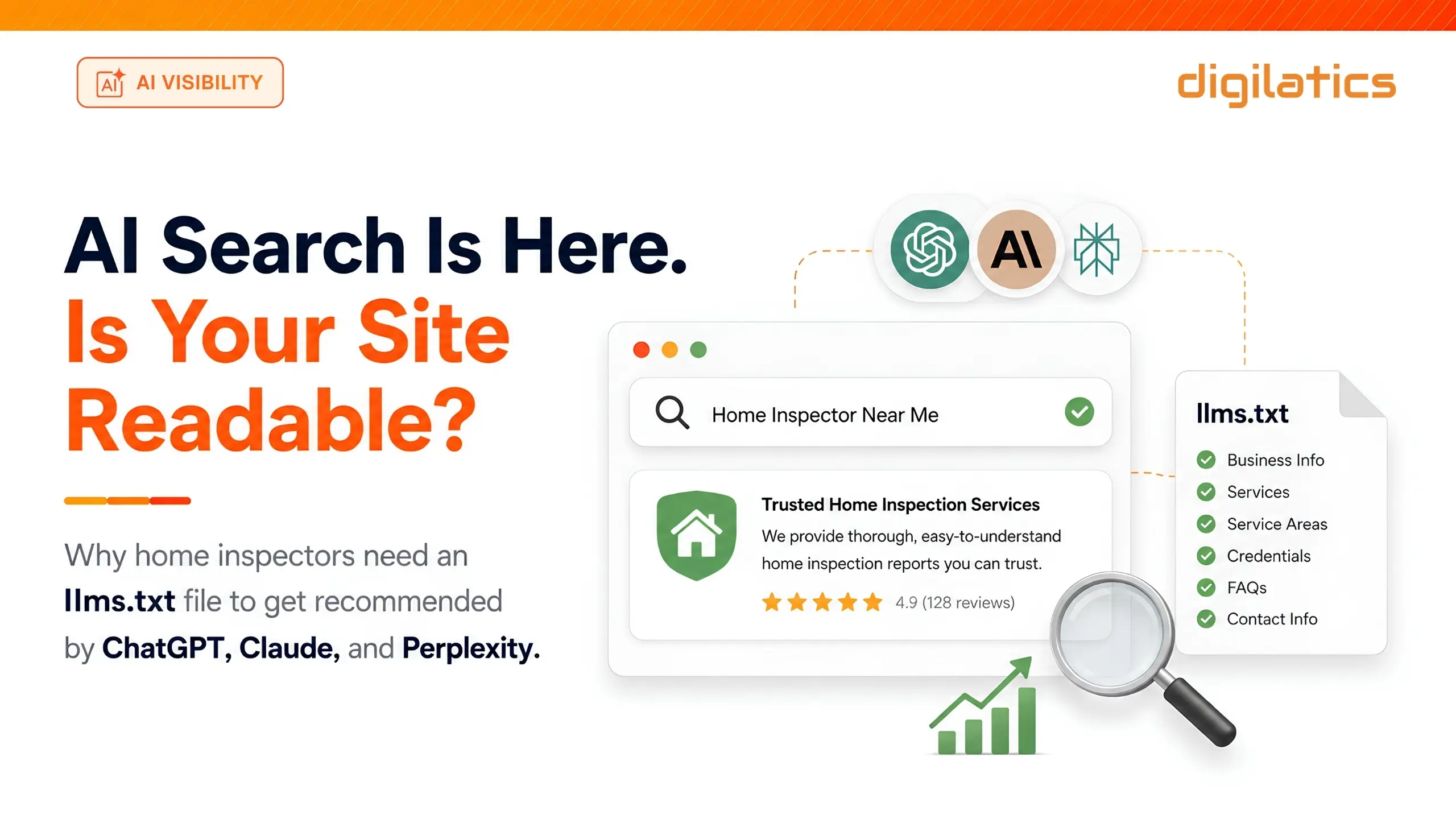
TL;DR: The 60-Second Summary
- What it is: llms.txt is an emerging, site-level data standard (a plain text Markdown file placed at [yourwebsite.com/llms.txt](https://yourwebsite.com/llms.txt)) designed to give AI assistants like ChatGPT, Claude, and Perplexity a clean, concise, distraction-free roadmap of your business data.
- Why it matters for Home Inspectors: Traditional websites are built for human eyes, filled with design code that confuses AI. An llms.txt file acts as an executive briefing document that feeds AI search crawlers accurate data regarding your exact services, service area coordinates, and licensing credentials.
- The Bottom Line: Implementing this correctly removes data ambiguity, massively increasing the likelihood that conversational AI engines confidently quote, cite, and recommend your home inspection business to local buyers.
LLMs.txt: The New robots.txt Every Home Service Website Needs
In the mid-2000s, as local business websites exploded onto the internet, a tiny, overlooked file called robots.txt became the invisible line separating businesses Google could find from those it couldn’t. The business owners who understood it early built a structural search advantage that compounded for over a decade.
Today, history is repeating itself. A new file is doing the exact same thing for a brand-new generation of AI crawlers. Most home service businesses have never heard of it. The few who do are quietly securing their spots in AI search answers while their competitors get left out in the cold.
That file is llms.txt.
What LLMs.txt Actually Is
An llms.txt file is a plain text document placed directly into the root directory of your website the exact same home as your traditional robots.txt file. It provides AI scrapers and large language models with a structured, human-readable summary of your business.
Think of it as an executive briefing document written specifically for an AI. Instead of forcing an AI bot to claw through dozens of pages on your site trying to piece together your pricing, services, and locations from unstructured marketing copy, llms.txt tells the AI directly: who you are, what you do, and what you want to be cited for.
Proposed by Answer.AI in September 2024 as an open standard, it has rapidly become a widely adopted shorthand for making websites natively readable for AI engines.
However, it is not a plug-and-play gimmick. A poorly configured file with inaccurate service descriptions, inconsistent geographic data, or conflicting signals introduces ambiguity. When an AI faces conflicting signals between your website text and your llms.txt file, its confidence score drops, causing it to skip your business entirely to avoid giving its user a bad recommendation.
Getting the data architecture right matters as much as having the file at all.
Why Home Service Businesses Need This More Than Anyone
Enterprise brands have massive structural AI visibility advantages. They have thousands of pages, dedicated development teams maintaining deep schemas, and massive backlink profiles that AI models have already swallowed during training.
Conversely, a local home inspection company with a 15-page website is almost invisible to an AI system trying to parse the local service landscape, unless it actively signals its identity in a form those systems can cleanly process with confidence.
When a homebuyer asks ChatGPT, Perplexity, or Google’s AI Overviews for a local recommendation, the AI isn’t just looking at a classic Google blue link. It is checking confidence signals.
Every AI model tries to answer three critical questions before recommending a local contractor:
- What do they actually do?
Generic marketing language creates ambiguity that AI systems resolve by guessing or skipping. Precise, service-specific data maps directly to buyer search intent.
- Where do they operate?
Service areas are the most common point of AI misinterpretation for local companies. Vague coverage descriptions produce inconsistent citation behavior. Explicit geographic signaling produces accurate matching.
- Why should they be trusted?
Certifications, state license numbers, and professional affiliations need to be machine-readable, not just visible on a page. Structured trust signals carry immense weight in AI trust matrices.
What Goes Inside a Home Inspection LLMs.txt File
A professionally constructed llms.txt for a home inspection business contains five distinct blocks. Each addresses a specific type of AI ambiguity that causes local businesses to be misrepresented or skipped in AI-generated recommendations.

1. Business Identity Block
A highly specialized framework mapping your corporate name, certifications, and target client profiles. The format and specificity of this block directly affect how AI systems categorize your business.
2. Service Definition Block
Each service is mapped to precise factual language rather than creative copywriting. This distinction matters because AI systems match service definitions to query language; traditional promotional text often fails this matching process.
3. Geographic Coverage Block
Explicit service area definitions at the city and county level. This is the highest-impact element for local AI search matching, and the most commonly misconfigured without professional oversight.
4. Key Pages Block
A structural map of your most important data nodes and landing pages. Without this, AI systems default to your homepage for all citations, missing deeper service-specific or location-specific relevance.
5. Trust and Authority Signals Block
Verifiable credentials structured specifically for AI data cross-referencing. AI systems weigh verifiable facts significantly higher than unverifiable claims.
What it looks like under the hood:
#Your Company Name
## Information
– Website: https://www.yourdomain.com
– Service Area: Dallas-Fort Worth Metroplex (Dallas, Collin, Tarrant Counties)
The Consistency Problem Most Businesses Don't See
Implementing llms.txt incorrectly is not neutral. It actively creates signal conflicts that AI systems resolve by either misrepresenting your business or deprioritizing it in favor of sources with cleaner, more consistent data.
The most common implementation errors we see include:
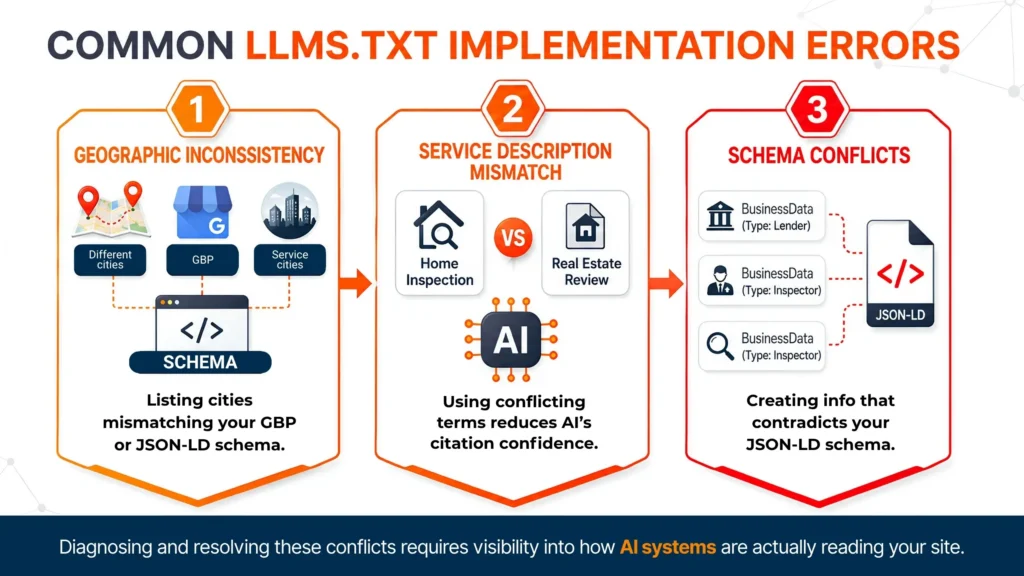
- Geographic Inconsistency
Listing service cities that don’t match your Google Business Profile (GBP) or your JSON-LD schema markup.
- Service Description Mismatch
Using conflicting terminology between your text files and individual service landing pages reduces the AI’s citation confidence.
- Schema Conflicts
Creating structured information inside the file that contradicts the existing JSON-LD schema on the website.
Diagnosing and resolving these conflicts requires visibility into how AI systems are actually reading your site, something that requires specific agency monitoring tools and methodologies, not just checking whether a file exists.
Case Study: What GreenWorks Proved
At Digilatics, we made AI visibility a deliberate strategic priority for our client, GreenWorks Inspection & Engineering.
Today, GreenWorks consistently maps into top local recommendations across major AI search platforms. In the past year alone, AI-attributed visibility drove 79 unique leads and $20,604 in directly tracked, attributable revenue, and that is only the strict, cleanly isolated slice of traffic we can track directly to AI user paths.
This success came from a complete AI visibility architecture—where the llms.txt file matched perfectly with their JSON-LD page schema, Google Business Profile data, and on-page content.
How it Fits into Your Site Architecture
To understand how this changes your technical setup, it helps to see where each file fits in your system:
File | Who It Talks To | What It Does |
robots.txt | Standard Search Engine Crawlers | Controls which pages bots are allowed to crawl and index. |
sitemap.xml | Search Engine Indexers | A map listing all active pages to ensure discoverability. |
llms.txt | AI Language Model Crawlers | Explains what the site means to ensure accurate interpretability and citation. |
The critical distinction: robots.txt and sitemaps are about discoverability (helping bots find your pages). llms.txt is entirely about interpretability (helping AI confidently understand what your business represents so it can recommend you).
What Happens After Implementation
Publishing your llms.txt file is the starting point, not the finish line.
AI systems crawl and update their knowledge of websites on their own schedules, which vary significantly across ChatGPT, Gemini, Perplexity, and Google’s ecosystem. Most businesses that implement correctly see measurable shifts in AI search presence within 60 to 90 days. The most reliable way to track progress is to run location-based queries in each AI platform before implementation, document the results, and retest at 30-day intervals.
What matters more than the timeline is understanding where llms.txt sits in the full AI visibility stack. It is the foundation layer, not the complete structure.
The AI Visibility Stack
Layer | What It Does |
LLMs.txt | Establishes site-level identity, services, geography, and trust signals for AI crawlers |
JSON-LD Schema | Delivers page-level structured facts: business data, services, reviews, in machine-readable format |
Content Quality & Specificity | Determines whether AI systems trust your content enough to cite it |
GBP Consistency | Reinforces geographic and trust signals across Google’s ecosystem |
Review Velocity | Signals ongoing business activity and customer satisfaction to AI systems |
Each layer depends on the accuracy of the layers beneath it. An llms.txt file built on inconsistent GBP data or a missing schema will underperform, not because the file is wrong, but because the signals it points to contradict each other. A complete stack, correctly configured and continuously monitored, is what produced GreenWorks’ top-5 rankings across ChatGPT, Gemini, Grok, and Perplexity.
Digilatics manages the full AI visibility stack for home inspection businesses, from llms.txt through ongoing AI search monitoring.
The Competitive Reality
Enterprise brands and technically sophisticated businesses began quietly deploying this infrastructure over the last 12 to 18 months. Local service businesses, including the vast majority of home inspection companies in the US, have not.
AI systems build familiarity with businesses through repeated crawling, indexing, and citation over time. The businesses establishing clear, consistent, structured AI signals now are building a compounding advantage that becomes progressively harder for late movers to close.
This is a genuine first-mover window. It will not stay open indefinitely.
Conclusion
In the mid-2000s, robots.txt was an obscure technical infrastructure that most businesses ignored, until not having it started costing them visibility. Today, it is table stakes. Every website has one. Every developer knows what it does.
llms.txt is at the same inflection point. Obscure today. Table stakes tomorrow.
The difference is the pace of change. AI search is not evolving on a five-year cycle. It is moving quarter by quarter. The businesses that act now do not just avoid falling behind; they actively capture AI visibility that their competitors are leaving unclaimed.
For a home inspection business, where local trust and conversational AI recommendations are increasingly the primary discovery channel, llms.txt is one of the highest-leverage investments available right now.
The file is simple. Getting it right is not. The impact compounds either way, in your favor or your competitor’s.
Frequently Asked Questions
1. Does llms.txt replace traditional SEO?
No. It works directly alongside it. Traditional SEO helps Google categorize and rank your pages for keyword queries. llms.txt helps AI models interpret your brand data for conversational, intent-based AI search queries. You need both.
2. Can I implement this file myself?
While the text format seems simple, correct implementation requires absolute data harmony across your website schema, your GBP, and your on-page structured data.
Because data conflicts actively lower an AI’s confidence score and can cause your business to get skipped, most home inspection businesses rely on professional deployment to ensure accurate synchronization.
3. How fast will I see results after publishing it?
AI bots crawl and update their knowledge bases on their own schedules. Most businesses see noticeable adjustments in conversational AI search results within 60 to 90 days as models refresh their training sets and indexes.
4. Does Google AI Overviews read my llms.txt file?
Google does not use llms.txt for AI Overviews or Search rankings. Google’s own team has confirmed this, it’s not a ranking signal, and there are no plans to change that. The llms.txt standard was built for the broader AI ecosystem: platforms like OpenAI, Anthropic, and Perplexity use it to cleanly parse your site’s content without wading through heavy website code. For Google, stick to what actually moves the needle: quality content, clean technical SEO, and structured data markup.
Ensure your business is machine-readable, trusted, and recommended across the AI ecosystem.


