
Why Clean Data, Transparent Tracking, and Ethical Attribution Matter for Home Service Businesses
Most brands treat Data Privacy Day as a compliance chore, a day to update cookie banners and check boxes while their actual revenue leaks through the cracks. They’re missing the point.
If you care about growth, Data Privacy is actually about Trust.
Trust is built on data integrity, transparent tracking, and ethical attribution.
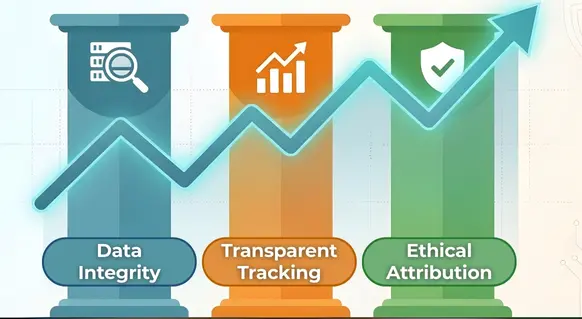
Without these, growth looks good in dashboards but breaks down in real business outcomes.
This piece keeps it practical and results-first.
No fluff. Just what it takes to build growth systems you can actually trust.
TL;DR: The Bottom Line on Data Integrity
- Privacy = Profit: It’s a trust exercise that directly impacts your bottom line.
- The Paper Growth Trap: Messy data creates phantom ROI. If the dashboard is green but the bank account is flat, you have a data problem.
- 3 Pillars: Clean data, transparent tracking, and ethical attribution protect both revenue and credibility.
- Traceability is Key: If you can’t explain the numbers, you can’t trust the growth.
- Partners Matter: The right partner shows you the truth, not just a pretty report.
Data Privacy and Data Trust Are Now The Same Problem
In the past, “Data Privacy” was something for the IT guy or the lawyers to worry about. Marketing was just about getting the phone to ring.
In today’s market, those lines don’t exist anymore.
When a homeowner fills out a form on your site or calls you, they aren’t just giving you their address; they’re giving you their trust. And they expect that trust to be reflected in how you run your business.
But trust isn’t just about “not leaking an email address.” For a Home Service owner, real trust shows up in your numbers. It’s the difference between a dashboard that looks pretty and a business that is actually healthy.
When your data and your trust aren’t aligned, you’ll start seeing these red flags:
- Channels that look profitable on paper but do not match cash flow
- You’re questioning if the “leads” your agency reported were actually just spam or existing customers calling to complain
- Your team is spending more time debating which numbers are “real” than they are actually booking jobs
“In the home services industry, trust isn’t built on a dashboard. It’s built on truth. If you can’t trace every marketing dollar to a real job, you aren’t growing; you’re gambling. Transparency is the only bridge to confident, scalable growth.” — Gabriela Paiva, Director of Marketing, Digilatics
Data Privacy Day is a good moment to ask a harder question: Can you trust the way your growth engine uses data, end to end?
Clean Data is the Foundation
Clean data is the difference between confident decisions and expensive guesses.
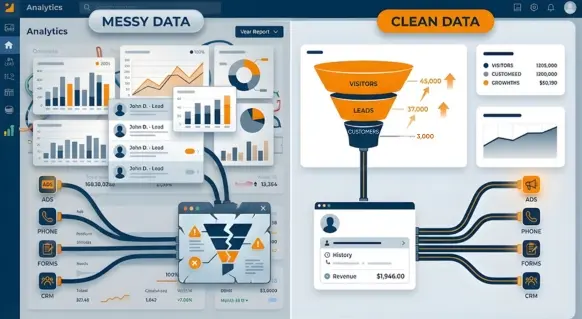
When data quality slips, issues show up quickly:
- Duplicate or missing events across platforms
- Conversions firing on the wrong actions.
- Broken connections between ads, analytics, CRM, and revenue
- Inflated or underreported numbers in dashboards
On the surface, activity still looks healthy. Underneath, the story is distorted.
In the home services business, this shows up clearly.
We often see a form fill, a missed call, and a callback counted as three leads. On paper, lead volume looks strong. In reality, it is the same homeowner trying to get help.
The result?
- Cost per lead looks artificially low
- Conversion rates look worse than they are
- Teams chase volume instead of fixing response time
That is not a privacy issue on the surface. It is a data integrity issue that quietly affects revenue decisions.
Data integrity does not mean collecting more. It means collecting the right signals consistently, so every metric you rely on is traceable and explainable
Ask yourself:
- Do we have a clear source of truth for leads, bookings, and revenue?
- Can we explain how any key metric is generated?
- Would this system make sense to someone new?
If the answer is no, both growth and trust are at risk.
Transparent Tracking Beats Black Boxes
The second pillar of trust is transparency.
If only one agency, vendor, or technical person understands your tracking setup, you do not truly own your data.
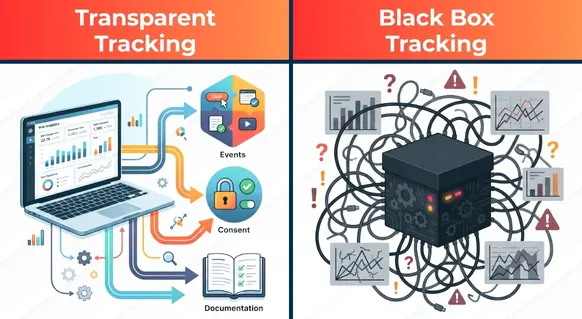
Transparent tracking means:
- Clear documentation
- Events mapped to real customer actions
- Consent-aware measurement
- Logic that can be explained in plain language
When numbers spike or drop, you should be able to see:
- What changed
- Where it changed
- Why it changed
That is how trust is built.
Ethical Attribution Builds Real Confidence

Attribution is where trust often breaks quietly. When tools or partners overclaim impact:
- Budgets get allocated based on false stories
- Stakeholders stop believing performance reports altogether
Ethical attribution means:
- Clear attribution windows and models
- Avoiding “everything is ours” logic
- Blending platform data with first-party truth
- Acknowledging uncertainty honestly
Good attribution does not make everything neat.
It makes expectations honest. And honesty builds confidence.
Is Your Partner Protecting Your Data or Hiding It?
You can invest in strong data practices, transparent tracking, and ethical attribution internally. If your external partners do not share those values, your system is still fragile.
On Data Privacy Day, it is worth looking not only at your tools, but at who touches your data:
- Agencies
- Developers
- Attribution vendors
- Platforms plugged into your stack
Questions worth asking:
- What data do you access, and where is it stored?
- Who inside your team can see it?
- Can you explain our setup clearly, without jargon?
- What would you refuse to track, even if asked?
- If we parted ways, could we fully own this system?
If answers feel vague or defensive, trust is already compromised.
At Digilatics, we believe growth teams deserve more than black box dashboards. You should know exactly how your data is collected, how your tracking is wired, and how your attribution model shapes the decisions you make.
When data is handled with integrity at every layer, trust becomes operational, not theoretical. That’s where most teams struggle, and where the right partner makes the difference.
Where Digilatics Fits In
At Digilatics, we help growth teams build data foundations they can actually trust.
That often includes:
- Auditing analytics and tracking for blind spots
- Cleaning and restructuring event data around real outcomes
- Rebuilding tracking with privacy and consent in mind
- Designing reporting leaders can trust, not just look at
If you want your growth story to be as strong as your growth numbers, it starts with data you can stand behind.
If this piece made you question how much you really trust your tracking, it might be time for a deeper look.
Growth built on shaky data is not growth you can scale with confidence.
Trust, once lost, costs far more than getting it right from the start.